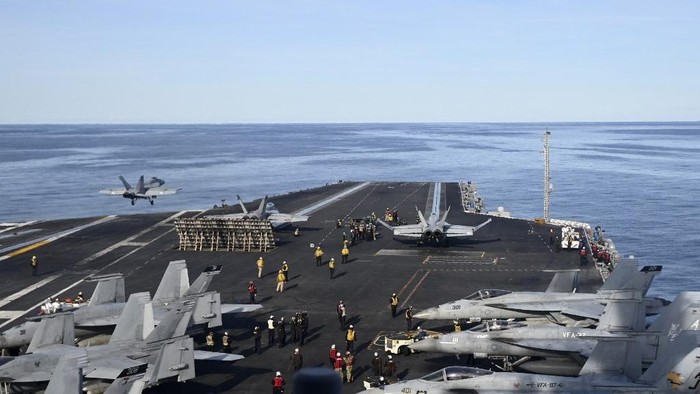
Saudi Arabia and Kuwait have reportedly lifted restrictions previously imposed on United States military access to their airspace and military bases, removing a significant obstacle to Washington’s efforts to secure commercial shipping routes in the Strait of Hormuz amid escalating tensions in the Middle East.
According to reports cited by Middle East Monitor and later published by The Wall Street Journal, the restrictions had initially been introduced following the launch of a US-led military operation aimed at reopening maritime access through the strategically vital waterway.
The Strait of Hormuz has faced severe disruption since conflict intensified in late February, after large-scale military strikes involving the United States and Israel against Iran triggered retaliatory attacks across the region.
Strategic Shift in Gulf Cooperation
The decision by Saudi Arabia and Kuwait is seen as a major strategic development, as both countries host key American military assets and play an important role in Gulf security architecture.
By restoring access, Riyadh and Kuwait City are effectively easing operational constraints for the administration of Donald Trump, which is seeking to restore secure maritime navigation through one of the world’s most critical energy corridors.
The Wall Street Journal, citing US and Saudi officials, reported that the Trump administration is now preparing to resume naval escort missions for commercial vessels transiting the Strait of Hormuz, supported by both the US Navy and Air Force.
The operation—known as “Project Freedom”—was temporarily suspended earlier this week after running for approximately 36 hours. Pentagon officials are currently reassessing operational timelines, with some US officials suggesting that escort activities could resume as early as this week.
Conflict Continues to Shape Regional Security
Regional tensions surged after the US and Israel launched coordinated military strikes against Iran on February 28. Tehran responded with waves of missile and drone attacks targeting Israel as well as Gulf states hosting American military facilities, including Saudi Arabia and Kuwait.
In response to the escalating conflict, Iran effectively restricted shipping movement through the Strait of Hormuz, while the United States imposed a naval blockade targeting Iranian maritime activity around the corridor beginning in mid-April.
Although a ceasefire mediated by Pakistan has technically remained in place since April 8, the truce is widely viewed as fragile. Peace negotiations held in Islamabad failed to produce a lasting settlement, prompting Trump to extend the ceasefire indefinitely without a defined timeline.
On May 5, Trump announced a temporary pause to Project Freedom while maintaining that the broader US maritime blockade would remain “fully in effect.”
Global Economic Implications
The developments surrounding the Strait of Hormuz continue to carry major implications for the global economy. Roughly 20 percent of the world’s oil and liquefied natural gas supply passes through the narrow waterway, making any disruption a direct threat to energy prices, shipping stability, and inflation worldwide.
The renewed support from Saudi Arabia and Kuwait may strengthen Washington’s ability to restore limited maritime security operations. However, analysts warn that the broader geopolitical risks remain unresolved as long as military tensions between Iran, the US, and Israel continue.
For energy-importing nations, including Indonesia, prolonged instability in the Gulf region could translate into higher fuel prices, increased logistics costs, and pressure on domestic inflation.
The latest move by Gulf allies signals that regional powers are increasingly being forced to balance diplomatic caution with strategic alignment as the crisis in the Middle East evolves.
#KiniMediaJakarta #KiniMedia #KiniMusik





Tinggalkan Balasan