


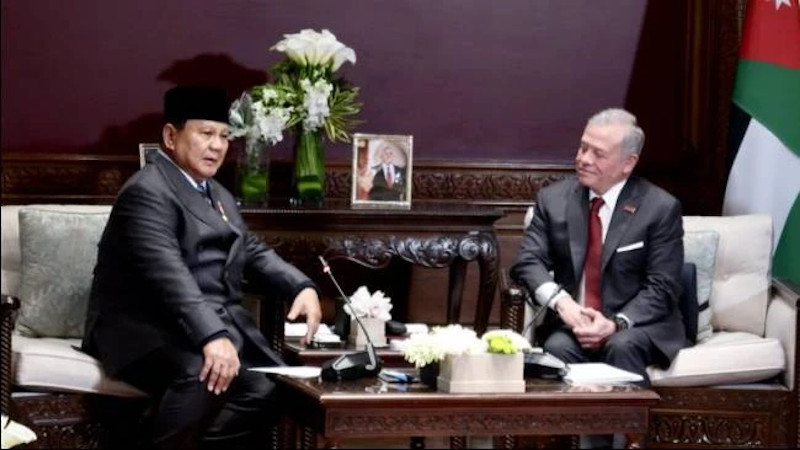
AMMAN — Indonesian President Prabowo Subianto held bilateral talks with Abdullah II in Amman on Wednesday (February 25, 2026), with discussions centered on the evolving situation in Palestine, particularly escalating tensions in the West Bank and Gaza.
The meeting formed part of President Prabowo’s overseas visit on February 24–25, 2026, following prior stops in the United States and the United Kingdom. Geopolitically, the sequence of visits — from major Western powers to a key Middle Eastern partner with historical influence on the Palestinian issue — underscores Jakarta’s calibrated diplomatic approach.
During the talks, President Prabowo expressed concern over rising violence affecting Palestinians in the West Bank, stating that continued escalation risks undermining peace initiatives, including efforts pursued through multilateral mechanisms such as the Board of Peace (BoP).
The remarks reaffirm Indonesia’s long-standing support for Palestinian statehood. However, analysts note that the broader strategic question remains: to what extent can bilateral diplomacy influence a conflict shaped by multiple regional and global actors?
President Prabowo also conveyed Indonesia’s readiness to deepen cooperation with Jordan in seeking constructive pathways toward de-escalation. Jordan holds a distinctive position in the conflict — geographically bordering the West Bank and politically playing a custodial role in Jerusalem’s Islamic holy sites — making Amman a pivotal stakeholder in regional stability.
King Abdullah II expressed appreciation for Indonesia’s consistent advocacy for Palestinian rights, describing Jakarta’s stance as an important element in sustaining momentum toward a peaceful resolution.
Symbolically, the meeting reinforces the continuity of Indonesia’s pro-Palestinian foreign policy posture. Practically, its effectiveness will depend on Jakarta’s ability to build broader diplomatic coalitions, both within the Arab world and among Western partners.
Amid an increasingly fragmented global landscape, diplomacy requires more than statements of solidarity. It calls for measurable action — whether through multilateral engagement, humanitarian assistance, or structured reconciliation initiatives.
The meeting in Amman signals Indonesia’s intention to remain an active and relevant voice in Middle Eastern affairs. The challenge ahead lies in translating moral positioning into tangible strategic influence at the international negotiating table.
Author: Faisal / FKY
#KiniMediaJakarta #KiniMedia #KiniNews #PrabowoSubianto #Jordan #Palestine #IndonesianDiplomacy #Geopolitics #MiddleEast