


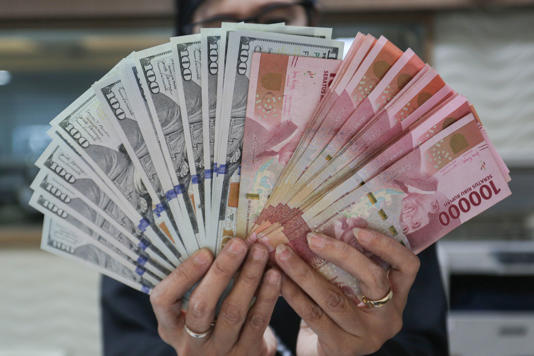
JAKARTA — Indonesia’s rupiah remained under pressure on Tuesday (Jan 20, 2026), edging closer to the psychologically significant level of 17,000 per U.S. dollar, even as the country’s stock market surged to a new all-time high.
Bloomberg data showed the rupiah opening weaker at 16,997 per dollar, before briefly strengthening to 16,976 by mid-morning. Despite the modest rebound, analysts warned that the currency remains vulnerable amid intensifying global risk aversion and growing domestic policy concerns.
The divergence between the currency and equity markets was striking. The Jakarta Composite Index (IHSG) climbed to an intraday record of 9,169, reflecting strong domestic equity momentum, while the rupiah continued to struggle against a broadly stronger U.S. dollar.
Global Tensions and Domestic Policy Signals
According to Fikri C. Permana, Senior Economist at KB Valbury Sekuritas, rupiah weakness is being driven by a combination of external and internal factors. On the global front, rising geopolitical tensions and renewed fears of a trade confrontation between the United States and the European Union have pushed investors toward safe-haven assets, lifting the dollar.
Domestically, markets are increasingly focused on questions surrounding the independence of Bank Indonesia (BI), following reports that Deputy Finance Minister Thomas Djiwandono is being considered for a Deputy Governor position at the central bank.
“There are concerns that Bank Indonesia’s independence could be perceived as weakening following Thomas’s nomination,” Fikri said.
In addition, investors are closely watching upcoming auctions of Islamic government bonds (SBSN) and Bank Indonesia foreign exchange securities (SVBI), which could influence short-term liquidity and dollar supply in local markets.
Optimism Meets Market Reality
Finance Minister Purbaya Yudhi Sadewa struck an optimistic tone, arguing that the record-breaking performance of the stock market signals continued foreign interest in Indonesian assets.
“The IHSG is at an all-time high. When the index rises, foreign capital is usually coming in. It’s only a matter of time before the rupiah strengthens as dollar supply increases,” Purbaya said on Monday (Jan 19).
However, data from the Indonesia Stock Exchange (IDX) complicates that narrative. Foreign investors recorded a net sell of IDR 708 billion on Monday, despite the benchmark index closing at a historic high of 9,133. The figures suggest that equity gains have not yet translated into sustained foreign inflows that would support the currency.
Addressing concerns over central bank autonomy, Purbaya emphasized that BI’s independence remains intact, stressing that there has been no direct government interference in monetary policy decisions. He also noted that BI Deputy Governor Juda Agung is being considered as a replacement at the Finance Ministry, framing the move as an institutional reshuffle rather than political encroachment.
A Test of Confidence
The rupiah’s weakness amid booming equities highlights a broader challenge facing Indonesia: maintaining policy credibility, institutional independence, and investor confidence at a time of heightened global uncertainty.
As global capital grows more selective and risk-sensitive, markets appear to be demanding clearer signals from policymakers that monetary autonomy and macroeconomic stability will remain firmly protected.
By: Faisal / FKY
#IndonesiaEconomy #Rupiah #FXMarkets #EmergingMarkets
#MonetaryPolicy #CentralBankIndependence #BankIndonesia
#GlobalMarkets #USDEmergingMarkets #CapitalFlows
#IHSG #AsianMarkets #Geopolitics
#KiniMediaJakarta #KiniMedia #KiniMusik